Recycling and Sustainability at Gardening Balham
 Gardening Balham is committed to creating an eco-friendly waste disposal area and a truly sustainable rubbish gardening area that supports local biodiversity and reduces landfill. Our approach combines practical on-site systems with borough-wide recycling practices so that customers and neighbours benefit from consistent, reliable, and low-carbon solutions. We aim to lead by example, showing how a neighbourhood gardening business can deliver green waste recycling, reuse, and responsible disposal while keeping operations efficient and community-focused.
Our recycling percentage target is ambitious but realistic: 65% of all garden and associated household waste diverted from landfill by 2030. That target covers composting, reuse, and collected recyclables. To reach it we separate green waste, paper and card, glass, and mixed plastics at source and work with borough-level schemes. Many local boroughs operate separate food and garden waste collections with clear sorting rules — balancing the practical needs of service delivery with the environmental aim of a high capture rate.
 We provide clearly labelled zones within our depot so teams and customers can use our eco friendly waste disposal area without confusion: a composting bay for woody and green material, a shred-and-store area for mulches, a small reuse corner for pots and tools, and discrete bins for dry recycling. This on-site separation mirrors the boroughs' approach to waste separation — food, glass, paper, plastic and garden waste streams are kept distinct to avoid contamination and maximise the value of materials for recycling.
Partnerships are central to our model. We work with local transfer stations and material recovery facilities that serve Balham and neighbouring Wandsworth and Lambeth. These transfer stations are essential hubs: they consolidate loads, ensure proper sorting, and divert material to specialist processors. By routing our loads through trusted transfer stations we can track tonnage, reduce double handling, and ensure that compostable material goes to accredited composting sites rather than incineration.
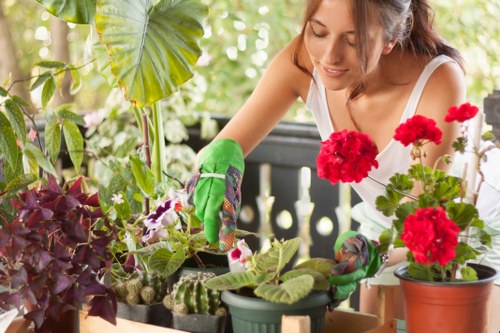 We also partner with charities and social enterprises to extend the life of useful items: pots, timber, hand tools and surplus soil are offered to community groups, allotments and reuse charities. Those partnerships benefit local charities, reduce waste, and support the circular economy. Our collaborations include community composting schemes, tool libraries and social projects that help redistribute usable goods instead of destroying them.
To make the sustainable rubbish gardening area practical for day-to-day operations, we run staff training and provide clear signage. Teams are trained to perform source separation during site clearance and garden maintenance, ensuring a higher-quality recycling stream. Education and simple workflows are as important as the infrastructure: a well-run green waste area depends on people recognising what belongs in each container and why it matters.
We maintain a transparent set of commitments and metrics. Our reporting includes monthly weights for: composted green waste, materials sent to local transfer stations, items donated to partners, and residual waste sent to proper disposal. Key operational elements include:
- Target: 65% recycling and reuse rate across garden and associated waste by 2030.
- Collection & Transfer: use of accredited local transfer stations serving Balham and adjacent boroughs.
- Partnerships: reuse charities, community composters, and social enterprises for redistribution.
- Low-carbon fleet: electric and plug-in hybrid vans for local collections to reduce emissions.
To support low-carbon logistics we operate a growing fleet of low-carbon vans and e-cargo bikes. These vehicles reduce local emissions and are more suited to Balham's residential streets. Where diesel vehicles are still required for heavy loads, they meet the latest low-emission standards and are scheduled to minimise empty runs. Combining route optimisation software with electric vehicles is one of the most effective ways we reduce the carbon footprint of our rubbish gardening operations.
 Behind every practical step is a commitment to continuous improvement. We audit waste streams quarterly and adapt our operations based on diversion performance and borough policy updates. That includes encouraging customers to separate at source, offering compost take-back for larger clearances, and expanding the range of materials we can divert to reuse partners. Our aim is to make the sustainable rubbish gardening area a simple, reliable extension of everyday gardening services.
 Sustainability at Gardening Balham is a mix of strong targets, practical infrastructure and local cooperation. We blend the terminology of an eco-friendly waste disposal area with the everyday priorities of gardeners: healthy soil, tidy sites, and fewer journeys to landfill. The borough approach to separating food, garden, glass and dry recycling informs our system so that what starts in a garden ends in the right processing stream.
We know that small design choices — bins that are easy to use, clear labels, scheduled collections to transfer stations, and partnerships that accept reuse items — compound into large gains. By combining a clear recycling percentage target with local transfer station routing and charity partnerships we turn what could be waste into resources for community projects and regenerative compost. Our low-carbon vans mean the benefits reach the neighbourhood with less air pollution and quieter streets.
Gardeners, neighbours and partners all have a role: from selecting the right bin to choosing services that prioritise reuse and composting. At Gardening Balham we provide the infrastructure, the vehicles, and the partnerships needed to keep Balham greener. Together we can make the eco-friendly garden waste area a standard part of local life — reducing landfill, supporting charities, and building resilient, sustainable neighbourhoods.